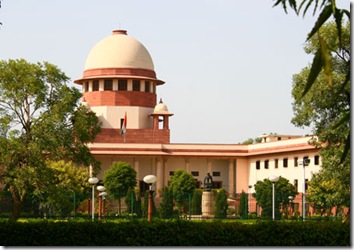
The Advocates on Record (AOR) exam pass rate has marginally bettered to set a three-year record. 22 per cent aspirants of the AOR designation have succeeded in their June 2013 attempt, according to results announced today.
107 out of 488 appearing candidates have cleared the exam for the prestigious designation for exclusive rights to appear, act and plead before the Supreme Court.
The exam was held on 3, 4, 5 and 6 June 2013, for the second time with new syllabus. 73 candidates are also eligible to re-appear, according to today’s result.
The 21.92 pass percentage is an improvement over the June 2012 figure of 14 per cent and the 2011 figure of 18 per cent. The total number of candidates writing the exam has increased marginally over the years, with 400 appearing in 2011 and 466 appearing in 2012.
A total of 22 out of the 107 who passed - around 21 per cent - were women this year.
New AoRs
Ms. Pooja Dhar Shri Satyakam Ms. Archana Pathak Dave Ms. Priya Aristotle Shri Manish Vashishtha Ms. Sneha Kalita Shri Pashupati Nath Razdan Shri Zulfiker Ali P.S. Shri Shantanu Krishna Shri Siddharth Rajkumar Murarka Shri Abdul Azeem Kalebudde Shri Shantanu Sagar Shri Neeraj Kumar Shri Ajit Sharma Shri Abhishek Sharma Shri Anupam Raina Shri Gautam Talukdar Shri P.V. Saravana Raja Shri Anantha Narayana M.G. Shri Suvendu Suvasis Dash Shri Jose Abraham Shri Anup Jain Shri Abhinav Malhotra Ms. Neha Vijayvargiya Ms. Lakshmi N. Kaimal Shri Sumit Gupta Shri Akshat Goel Shri Viplav Sharma Shri Sunny Choudhary Ms. Vemika Tomar Shri Aditya Singh Ms. Pritha Srikumar Shri T.V.S. Raghavendra Sreyas Shri Vikram Singh Shri Raj Kamal Ms. Mihira Sood Ms. Preetika Dwivedi Shri Santhosh Krishnan Shri Vikas Kumar Ms. Anushree Prashit Kapadia Shri V. Shyamohan Shri Ankur Sood Shri Ashwarya Sinha Shri Anup Kumar Md. Rashid Saeed Ms. Anindita Pujari Shri Sachin Patil Ms. Reshmi Rea Sinha Ms. AltafFathima Shri Bipin Bihari Singh Shri L. Roshmani Kh. Shri Avinash Sharma Shri Samar Vijay Singh Shri Sarvesh Singh Ms. Pakala Ratnamala Shri Gopal Verma Shri Neeraj Kumar Gupta Shri Atul Babasaheb Dakh Shri Danish Zubair Khan Ms. Jasmine Damkewala Shri Dilip Annasaheb Taur Shri Debojit Borkakati Shri Narender Kumar Verma Shri Rakesh Mishra Shri Zangpo Sherpa Shri Anupam Mishra Shri Sadineni Ravi Kumar Shri Abhishek Agarwal Shri Mohan Kumar Ms. Pinky Behera Shri Nar Hari Singh Shri Sarvam Ritam Khare Shri Arvind S. Avhad Shri K. Krishna Kumar Shri Suhaas Ratna Joshi Shri Amol B. Karande Shri Gaurav Goel Shri Kumar Mihir Shri Prahlad Kumar Ms. Madhu Tyagi Shri Sachin Gupta Ms. Vaishnavi Krishnamani Shri Satish Kumar Shri Sanjeeb Kumar Panigrahi Shri Rajiv Yadav Shri Amit Kumar Singh Shri Ashish Rana Shri Akshat Kumar Shri Amit K. Nain Shri Prakash Ranjan Nayak Shri Harshad V. Hameed Shri Sanjay Rastogi Shri Subhasish Mohanty Shri Jayesh K.Unnikrishnan Shri Ram Naresh Yadav Shri Atul Kumar Ms. Rashmi Singh Shri Sanjeev Kumar Ms. Shashi Kiran Shri Neeraj Kumar Sharma Shri Ramendra Mohan Patnaik Shri D. Ashok Rajagopalan Ms. Arti Gupta Shri Pradeep Kumar Mathur Shri Avadh Bihari Kaushik Shri Roopansh Purohit Shri Anil Antil
Comments
-Proud Nalsarite
Do persons filing vakalats in the SC need to possess a "higher" degree of legal knowledge than lawyers generally? If so, it is a shameful affront to all other lawyers as well as the courts before whom they appear.
If not, is it an exam for the sake of having an exam? It seems to me the supreme Court has invented a synthetic 'elite' by the creation of the AOR system. By definition 'elite' means 'above average'.
But above average in what ??
Surely AORs cannot be more knowledgeable than lawyers as a whole simply because a vast number of lawyers don't give the exam. Then again many lawyers cannot give the exam because of the odd eligibility criteria (practice in Delhi, chamber in Delhi, etc. etc.)
At best AORs are a little more knowledgeable than the AOR-candidates who did not make it.
But even assuming there is some advantage by having more 'knowledgeable' lawyers file vakalats before the highest court of the land, the biggest mystery is why they are so selective about not letting more candidates pass the exam. It is my impression that they flunk a bunch of people not because their knowledge is inadequate but that most who flunked were arbitrarily flunked just so the remaining AORs can brag about how hard it is to be an AOR. It’s like banging your head against a wall for days just so you can later brag that you banged your head against a wall for days.
There is no such arbitrary flunking out at law school or the NY bar exam. At some graduate schools like the Harvard MBA program or in some law firms, they do flunk out (or sack) the bottom 10% every year. That is an arbitrary quota. But their reason is to motivate all the students (or associates) and eliminate the notion that once you are admitted to the course of the firm, you can just loaf. Loafing is not a problem for AOR applicants. Neither are AOR applicants being trained at taxpayer expense. So the question of why there is a need to 'weed out' a whole bunch of them is one of the greatest unsolved mysteries of the 20 and 21st centuries.
It's pretty much insane. A guy busts his ass to get into law school. Then he busts his ass for five years to graduate *that*. Next comes the belatedly introduced Bar Exam where who knows what might happen on a bad day. And then starts the highly dangerous business of practising before any court for a number of years in return for peanuts. After all of that you need to test that poor guy and bar him from signing a vakalat because he was not in the top 5% no matter how well he scored ??? WTF
No wonder than that most law school graduates don't give a rat's ass about practicing. Sado-masochism isn't for everyone.
I'm still trying to figure it out.