Alongside 22 other Indian Universities, Jindal Global University (JGU), the parent institution of the JGLS Sonepat law school, has been ranked by UK-based academic careers counselling company Quacquarelli Symonds (QS), in its annual top 1000 global university rankings.
However, the methodology and access to QS remains somewhat hazy, at least so far as provided on its website (we have reached out to QS for comment), and is very amenable to ‘rank hacking’ by enterprising institutions.
JGU founding vice chancellor Prof Raj Kumar said in a press release: “This is an extraordinary international recognition for a university which is barely a decade old. Our commitment to maintaining the highest standards of excellence since our founding has helped us achieve this distinction.”
He added: “In September 2017, we first broke into the QS BRICS University Rankings. We then set up the Office of Rankings, Benchmarking and Institutional Transformation (ORBIT) under the leadership of Prof. (Dr.) Ashish Bharadwaj (Dean, Jindal School of Banking and Finance) and Prof. Arjya B. Majumdar (Director, Office of Academic Planning, Inter-disciplinarity and Coordination) to analyse the methodologies of rankings. In 2018, we broke into the QS Asia University Rankings and have continued to show exemplary performance this year by breaking into QS world top 800. We will dedicate ourselves to the efforts to build a world class university.”
Who goes into a ranking?
JGU’s new benchmarking office seems to have yielded results, despite according to JGU’s press release, “historically, university rankings have favoured universities that are oriented towards Science, Technology, Engineering, Mathematics (STEM) disciplines and Medicine”. According to its statement, “JGU is the only Indian university to challenge this tradition solely focusing on social sciences, arts, humanities and professions such as law, business administration and architecture”.
That advantage for science-y institutions does seem to be the case in the QS rankings, somewhat.
The highest-ranked Indian universities in those rankings are IIT Bombay, IIT Delhi and Indian Institute of Science, in the top 200 (see table below).
Indian institutions ranked from 200 to 500 are: the IITs Madras, Kharagpur, Kanpur, Roorkee and Guwahati, as well as University of Delhi in 474 (we have excerpted the data going into Delhi University’s rankings, by way of example, on the right).
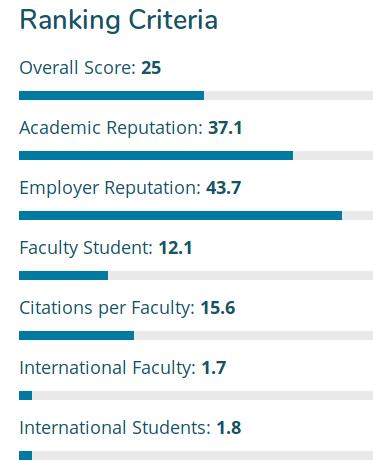
However, after the 500s ranks, the transparency of the rankings seem to break down slightly, purely according to the data supplied on QS’ website.
In 651-700, is Jadavpur University, whose only “ranking criteria”, according to QS, was a rating of 43.4 in citations per faculty, which is one of the six ranking criteria amongst:
- Academic Reputation (making up 40% of the total ranking),
- Employer Reputation (10%),
- Faculty/Student Ratio (20%),
- Citations per faculty (20%),
- International Faculty Ratio (5%), and
- International Student Ratio (5%).
Same story for other Indian universities in the lower ranks: Manipal Academy of Higher Education has one single ranking criteria out of six, for a faculty student ratio of 53.3 (and research output - papers published adjusted by size of university - of “high”, though it’s not clear if that factors into the rankings).
In the 750-800 ranks, just ahead of JGU, are Anna University, which only has one data point for “citations per faculty” of 45.3, with a research output of “very high”); and Jamia Milia Islamia, with “faculty student” ratio score of 44.9, and research output of “very high”.
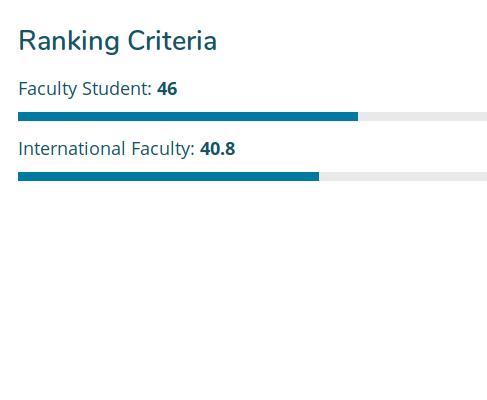
Jindal, however, has two recognised ranking criteria: “faculty student” ratio score of 46, and an “international faculty” score of 40.8 (while its “research output” is “medium” - a lower research output is perhaps also explainable by its humanities focus, versus generally more voluminous science research).
Below JGU, in the 801 to 1000 ranks, are Aligarh Muslim University, Amrita University, Banaras Hindu University, Birla Institute of Technology and Science Pilani, Savitribai Phule Pune University, Thapar Institute of Engineering & Technology, University of Calcutta, University of Mumbai, and Vellore Institute of Technology (VIT). None of these have scores in more than two ranking criteria (most, in fact, have only one criteria with a score).
How useful is a low QS ranking?
Therefore, one big question is, how exactly is it possible to judge any of those universities as being in the 1000 best globally, purely on the basis of a one or at most two criteria, such as faculty student ratio or international faculty?
This is slightly puzzling, and does cast a bit of doubt on the worth and quality of those rankings in the lower reaches, beyond merely giving bragging rights to a university that’s on it.
It’s also reasonable enough. Doing thorough research on 1,000 universities globally and trying to authoritatively establish six metrics for each, is an exercise beyond most, even perhaps a 250-staff company such as QS, whose primary business seems to consist of “world tour conferences” (in which MBA candidates meet business schools), and a “QS World Grad School Tour”, which visits 47 cities in 31 countries, “bringing the complete A to Z of postgraduate programs to over 40,000 prospective master’s and PhD students”.
This might explain why “international student ratio”, for instance, is even a factor in those rankings at all: a higher international student ratio would be a useful data point for QS’ main target audience of international students who are looking for a postgraduate law school anywhere, including in India.
And by that metric, JGU is probably one of the best-positioned universities for international post-graduate students in the humanities.
But, QS’ global university rankings is also probably primarily (and understandably) a PR exercise, besides helping it establish connections to global institutions and giving it data so it can advise budding post-grad students.
Outside of perhaps the top ranks, QS does not appear to be very useful in any comparison amongst India institutions inter se, and the rumoured ambitions of some NLUs to get ranked in QS, seem somewhat pointless (unless they are planning to use that to attract more international students, or, for bragging rights).
And according to an FAQ on its website, pureplay law schools probably aren’t eligible for the world rankings anyway: “to be eligible for inclusion in the QS World University Rankings, a university must teach at multiple study levels (i.e. both undergraduate and postgraduate), and conduct work in at least two of five possible faculty areas (arts and humanities; engineering and technology; social sciences and management; natural sciences; life sciences and medicine)”.
QS’ separate top 300 law school rankings may be a different story and could theoretically include Indian law schools; however, the lowest-ranked law schools there from last year were cited with at least six full metrics in their ranking criteria, which likely puts this outside JGU’s current submissions (as well as probably most NLUs’).
We have also reached out to JGU dean Prof Raj Kumar for comment.
We have put some questions to QS via email, asking it to confirm the following:
- how can a university participate in QS, whether fees are payable, and whether single-subject institutions, such as pureplay law schools, are excluded from the world rankings.
- How universities can appear in the rankings with only two mentioned data points.
We had sent the first of those questions to QS last year, but had received no response.
Comments
- Your Senior
Not a rumour. Rahul Singh said so in this interview that he wants to get NLSIU in the rankings.
http://www.sociolegalreview.com/a-plausible-road-map-to-nlsius-future/
https://twitter.com/ShashiTharoor/status/1141262431210967040
QS 2019 Rankings | Reporting period: Academic Year 2016-17
Total Faculty reported by GU to QS: ~285
Total faculty reported in the AQAR (NAAC): 234 out of which 26 are others (Probably RAs and SRAs - RAs cannot be reported as faculty as per QS process) | http://iqac.jgu.edu.in/document/aqar_16-17.pdf
QS 2020 Rankings | Reporting period: Academic Year 2017-18
Total Faculty reported by GU to QS: 432 | https://www.topuniversities.com/universities/op-jindal-global-university
Total faculty reported in the AQAR (NAAC): 277 out of which 36 are others (Probably RAs and SRAs - RAs cannot be reported as faculty as per QS process) | http://iqac.jgu.edu.in/document/AQAR_17-18.pdf
AQAR for the academic year 2018-19 is not available on GU's IQAC website. Not so strangely, GU has never participated in NIRF.....maybe beacause one has to disclose actual data for the previous 5 years and also make it public on the University's website.
I wish at least one NLU gets into this list some day.
Also, @kian - it's world university rankings called WUR and not college rankings.
IIT KGP (3 year LLB for BTech grads)
DU (3 year)
Jamia
Jindal
AMU
BHU
Pune
Mumbai
Calcutta, and
VIT