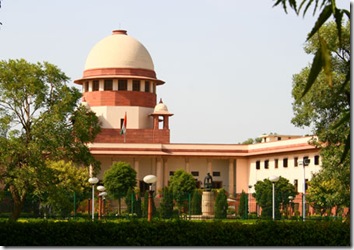
In its 56-page judgement the bench, headed by Chief Justice of India S.H. Kapadia, said that if publishing news related to a trial would “create a real and substantial risk of prejudice to the proper administration of justice or to the fairness of trial”, the court could grant a postponement order, temporarily gagging electronic or print media from reporting on the case.
The bench wrote:
The test is that the publication (actual and not planned publication) must create a real and substantial risk of prejudice to the proper administration of justice or to the fairness of trial. It is important to bear in mind that sometimes even fair and accurate reporting of the trial (say murder trial) could nonetheless give rise to the “real and substantial risk of serious prejudice” to the connected trials.
In such cases, though rare, there is no other practical means short of postponement orders that is capable of avoiding the real and substantial risk of prejudice to the connected trials…
The principle underlying postponement orders is that it prevents possible contempt…
In the light of the law enunciated hereinabove, anyone, be he an accused or an aggrieved person, who genuinely apprehends on the basis of the content of the publication and its effect, an infringement of his/ her rights under Article 21 to a fair trial and all that it comprehends, would be entitled to approach an appropriate writ court and seek an order of postponement of the offending publication/ broadcast or postponement of reporting of certain phases of the trial (including identity of the victim or the witness or the complainant), and that the court may grant such preventive relief, on a balancing of the right to a fair trial and Article 19(1)(a) rights, bearing in mind the abovementioned principles of necessity and proportionality and keeping in mind that such orders of postponement should be for short duration and should be applied only in cases of real and substantial risk of prejudice to the proper administration of justice or to the fairness of trial.
Such neutralizing device (balancing test) would not be an unreasonable restriction and on the contrary would fall within the proper constitutional framework.
Mint reported that the Broadcast Editors Association counsel was happy with the ruling:
The “court was very fair. It has tried to balance the freedom of the press with individual right to personal liberty,” said Shailendra Swarup, the lawyer representing the Broadcast Editors Association who was present in court. “It has said that reporting is allowed as long as you are reporting fact and not passing a judgement. However, it has also offered an opportunity to the aggrieved party to seek temporary postponement of reporting if it is seen as being prejudiced.”
Swarup said he was waiting for a copy of the judgement before he could make further comments.
Meanwhile, social network Twitter was ablaze with debate.
@CourtWitness1 tweeted:
Thankfully no concept of super-injunction in Indian law so media cannot be entirely shut out
As always, one small loophole. Nothing prevents reporting of postponement proceedings ;)
Former Supreme Court journalist @nikhilkanekal said:
Don’t be fooled by this ‘no blanket ban’ nonsense. This judgment has messed with the freedom of speech and expression.
We don’t need courts to fix our journalism. Readers/Viewers are smart enough to decide.
Also, I might be prevented from covering a trial because some other nut messed it up with his readers.
CourtWitness1 responded:
But seriously, it also means that media has a chance to defend itself before contempt action is taken instead of after.
Lawyer @maneesh312 noted:
It had been absolute waste of time, more or less it was like a good for nothing mere academic exercise
Fellow advocate @VizLaw responded:
Spot On! For much of judgment, it felt like again listening to Prof. Upendra Baxi on Comparative Constitutionalism
The official Twitter account of Bloomberg TV India legal journalists @thecourtroom1, took a different tack and tweeted:
yes harmless ruling but [that] meant weeks of no matters taken by 5 judges mounting pendency
The Courtroom journalist @priyalguliani argued on Twitter that she had seen cases in the Bombay high court where live flashes were being sent from courtrooms: a “lethal” practice. “Even today in SC many times before the order is fully pronounced [people] rush out to put [news out first]: lethal again.” “Wish these issues were addressed by Kapadia which is a serious threat in my opinion,” she added.
What’s your view? Do leave a comment.
For more background about the case, see the below stories:
- Explained: Why Kapadia’s SC is putting the media on trial
- Seniors shoot down ideas as SC wrestles with press freedom, not Twitter, in Kapadia media watch project, day 1
- Day 2: SC amiable to media, mulls judicial delaying powers for prejudicial publication
- SC media trial day 3: Editors’ counsel Dhavan pitches internal regulation of ‘non-yellow’ media
- SC media trial day 5: Shanti Bhushan condemns media regulation [+Exclusive: download Bhushan, Rajeev Dhavan, AG written submissions]
Comments
This is case where interim relief is more prejudiced than final relief. Ban on publishing in perpetuity could anyways be not granted under law. As the issue was limited to temporary time period till matter was subjudice .
The essence of the judgment is that in all those matters where we have seen media performing a pro active role in surfacing matter of public interest and consistent following of investigation and court proceedings.Now owing to broad mouthed nascent principle is vulnerable enough to exploited to Gag orders on the healthy criticism,check by the media while covering matters of Public Importance.
I am very much confused by the "actual and not planned" bit. Once something is published by a national daily and covered by TV channels, what good would restraining that retrospectively do to presumption of innocence and right to a fair trial? I am even more confused as the judgement uses the term “prior restraint” and illustrates, by reference to case law, that such restraint could be constituionally valid. Then why say that "planned" publication cannot be restrained by a "prior" order? Why cannot one apply for a John Doe order restraining media from covering cases that deserve such protection? Thoughts anyone?
P.S. While this judgement has a lot of observations and considers the law in various jurisdictions, the judgement does not really "lay down" a general guideline. The judgement itself says that it is following the nine judge bench decision in Naresh Shridhar Mirajkar v. State of Maharashtra.
assume legislative functions or protect themselves. by citing british and american law they are trying to impress forgetting thereby that technology has given rights to people to express opinion supreme court cites american and british law of 80s forgetting that even supreme court proceedings of usa and canada and uk are live. courts trying to fierecely protect themselves from the onslaught of judicial accountability billno missreporting if the proceedings are live