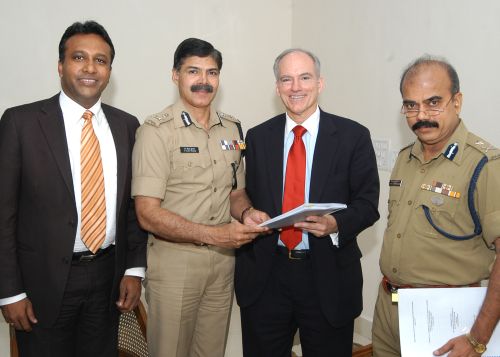
The £2.4m (Rs 16.6 crore) training programme for the first batch of police officers commences operation from JGLS’ centre for penology, criminal justice and police studies headed by Professor Oishik Sircar.
JGLS founding dean Professor Raj Kumar told Legally India: “The program will essentially have two stage components: In the first stage, two weeks of the training will be held in Cambridge and the second stage component involves four weeks of training in India.”
He said that the Cambridge part of the training will engage UK based experts who will teach 420 Indian police executive over a period of three years.
“Cambridge University has a very established police executive program and this program essentially provides for the framework of training police officers around the world on a number of issues other than just investigation.”
Kumar (pictured left) noted that police would be trained in law enforcement and the criminal justice system to improve the efficiency and effectiveness of the whole system.
Part of the £2.4m contract value of the training programme would be paid to JGLS, explained Kumar.
He said: “Professor Lawrence W Sherman, who is a professor at the University of Cambridge and heads this police executive program, identified us their partners when he was visiting India a few years back.
Together we applied to the Ministry of Home Affairs under GOI [Government of India] for seeking this opportunity to train the police officers, which is a huge, elaborate process. We made our application almost two years back.”
Kumar said that he felt that winning the contract was an important achievement for the research centre of his law school.
“Certain things we believe universities ought to do: one is teaching, second is research and the third important aspect is capacity building, which means working very closely with Governmental, inter-governmental organisations, non-governmental organisation as well as other institutions of learning including the world’s top most institution like Cambridge to improve the quality and functioning of our existing institutions through shared knowledge and experience.”
Cambridge University Professor Lawrence Sherman said: “Our joint work with the Indian Police Service is a major step forward in the history of criminology, integrating knowledge and practice on a broad scale at the highest levels of the police institution.
“Yet it is only one of many steps we hope to take together. The Cambridge-Jindal partnership will help to build a major research centre in India , where questions of crime prevention can be studied with as much rigour as questions of epidemiology and disease prevention.”
The parties signed the agreement to enter into the training contract at Sardar Vallabhai Patel National Police Academy in Hyderabad on 11 March 2010.
Comments
jindal is truly a world class law school..........
most big national law schools have these initiatives.. its not such a novel initiative after all.
And one wonders whether such a huge payment to JGLS makes sense. While I am sure the training will be of good quality, the limited point is that it would be more cost effective to appoint one of the national law universities. Considering this is taxpayers' money, the procurement must be rational.
Its really an achievement for JGLS to got such an opportunity even before its full one year Establishment!
And the reason why this made news and not NALSAR and NLU training others is because news is reported as it happens and not half a decade after it occurs. NALSAR and other institutes have been training public servants much before legallyindia came into the picture. Also, legallyindia is doing a favour to the very soothsayers who, in earlier posts, demanded to know what JGLS has done to even garner a review.
Well now you have your wish. So stop yer bitching.
With regards to your comment on JGLS's high fee structure I remember way back in 2005, the NLUs used to charge no less than Rs. 1,000/- for application form for entrance exam .... I have even seen sons of chaiwallas and bus drivers could not afford to even sit for those exams, leave alone spending Rs. 5 lacs for the course. So, please dont talk about the fee structure.
Somebody's father can afford to send him to UK , somebody to JGLS , somebody to Amity/ ICFAI/ Symbiosis, somebody to NLUs and somebody's father cant even buy form for his kid . So it all depends on how fat your dad's pocket is.
One more thing Zia Mody was educated in Cambridge and Harvard .... she is today one of the finest corp lawyers in India, but please don't forget everybody's dad cant afford to spend on his child's education like Soli Sorabjee did .... so dont talk about elitist and high fee structure and all . It really doesnt matter how she managed to study in UK and US.
If Jindal can influence govt. and impress Cambridge then its his talent and he deserves it. Today even the govt. understands the benefit of PPP or any sort of alliance with the private institutions.
1) Harvard India campus
2) Oxford India campus
3) Yale India campus
4) Columbia India campus
5) Cambridge India campus
6) Stanford India campus
7) Berkeley India campus
8) Pennsylvania India campus
9) JGLS...in tie up with a foreign univ
10) NLS/NUJS/NALSAR etc.... the only one who will recruit for your colleges will be the likes of Chopra & Khanna & Kalra LLP Third Class Trial Court Advocates, New Delhi
Yale will never come to India
Trust me guys, the NLUs aren't really concerned about JGLS. The comments were from the viewpoint "whether spending SO MUCH OF taxpayers' money to train govt. officers is justified". #11 spoke of PPP and public procurement. But then, there is always a bidding in huge public procurement to ensure that the govt. doesn't get a raw deal from the pvt. sector. Guys, the simple point is, JGLS would become a great lawschool maybe, with all the foreign tie-ups and foreign profs. But will they be adding so much value to domestic law training so as to charge such high fees? Wouldn't it be wiser for the govt. to approach universities that have proven standards and save public money? Or is it all nice to meet the JGLS chairman at some party and strike a deal that doesn't make sense in terms of economics, esp. coz its public money being spent.
Even if the picture you paint becomes a reality, what won't change is that the law college you attend / have attended would remain a third rate thing producing so-called-lawyers who are so frustrated with the NLU placements that they post such blogs :D So, are you with some third rate trial court advocate or what? Seems your college is where NLUs will be in 2025 :P My, when NLUs take over trial courts in 2025 (coz Harvard Yale is at big law firms), what will be left for u? Not even the lower courts.
However, another thing to note is that JGLS' strength lies in foreign qualified faculty who may not add much value for domestic law training. Also, when so much public money is spent, the question that arises is "was the project bid out" or "was fair analysis done" before spending taxpayers' money when it may have been available cheaper. I guess the NLUs could have provided the service at cheaper rates (as they have been doing over the years). If JGLS is offering better stuff, is it really that much better? These are of course in-the-air questions! But good for the debate. After all, its a 16 cr. question :D
#16
#17
Another remarkable initiative of JGLS is to have all the key people who have been the vanguard of legal education in India to be actively involved in the institution. I know that Professor Madhava Menon who is the father of modern legal education in India sits as a Member of the Academic Council of O.P. Jindal Global University.
I am very pleased to see the Business School of this University is promoting multidisciplinary learning. They have challenged every typical view of a private University in India. The problem is most people don't take the effort to rigorously examine the institutional profile before airing out unwarranted critical comments. I know them well as I have discussed with the founding members of ISB in Hyderabad.
Another interesting factor to note is that the O.P. Jindal Global University will be the first of its kind in India is unlike most top business schools in India (IIMs and ISB) which are alone stand alone Business School and unlike most top law schools in India (NLSs), this University has both a law school and a business school which gives great opportunities for students to have a multidisciplinary learning experience.
With the potential entry of foreign Universities in India, the Jindal initiative is a revolutionary initiative like that of ISB. But what makes Jindal even more transformative is the fact that it is a statutorily created legal entity as a University under the Indian law. This makes it even more an ambitious and exciting venture.
I m pretty sure that JGLS will also create neo-age politicians in our country. Presently, there is a dearth of young politicians in our nation. Politicians like Obama, Hilary Clinton, Bush, etc. are all from top law schools of the US .... Well, till date we didnt witness any politician from NLS ( the premier law school of the nation) but who knows JGLS may create outstanding young politicians like Rahul Gandhi and Sachin Pilot , because of their global exposure. After all law school is just not about bagging a 12 lakh placement from Amarchand. This is what Jindal has identified very well.
15-20 years from now you may find JGLS grads framing policies on various issues where SILF members (the big fat managing partners) will avail prior appointments and meet them to discuss their interest getting affected and request them to make laws which supports them (just like SILF partners met Pranab Mukherjee to request him not to charge service tax and also not to allow entry of foreign law firms) .
So the difference between JGLS and NLS will be the former will understand its importance while the latter will identify its talent. And the difference lies just because of the global exposure ( with talent) which is more useful than becoming national and sell your talent.
As for the National Schools' claim about having similar programs, besides the points about the foreign University choosing its partner, and such reports coming out over others due to Legally India's recent inception, as well as quality, one of the simple reasons why Legally India has chosen to report this program over other existing ones, is due to the sheer magnitude of the project. If the NLS/NUJS etc. programs can match up to this magnitude, then I concede that those programs should be equally well-publicised by the respective organizers as well as the correspondents of this very journal.
Private schools are at a huge disadvantage vis a vis the NLS as they have to create centres of excellence out of their own funds and are unable to pick the deep pockets of the government. The day the government starts charging market rates for education in state run schools, will be the day the NLS will have to prove whether they can attract the best talent on the basis of their faculty and programmes.
JGU has provided a great many scholarships to ease the financial burden on the less economically favoured, but they can never bring their fee structure down to that of the govt funded NLS. If more of our super rich would endow such colleges from genuine philanthropic motives rather than pseudo philanthropy (as most are) we would see a sea change.
2. Who has identified the need for this training - state police ? NPA? MHA? or Jindal Law School ? The news item says, it is Cambridge and Jindal together applied to GoI. How this combo has identified this specific need? For improving policing efficiency all of a sudden? oh, of course for their business spread. At whose cost? It is one of those hundreds of thousands of public money planned squandering. Is it not? why bother?
3. Certainly such high profile training will provide some learning experience to some. Who will acquire this experience and how will this be used further? Would it not have been a wise thing for MHA to have got Cambridge and National Police Academy aligned together for this. The 16 crs could have helped NPA in setting up a center for focused continuing education where it could have brought all the world class policing knowledge and experience into one fold and forever it might help police training in India.
Dear legal fraternity, if you ask these questions, somewhere down the line India's public spending might improve and focused for right purposes and right results.